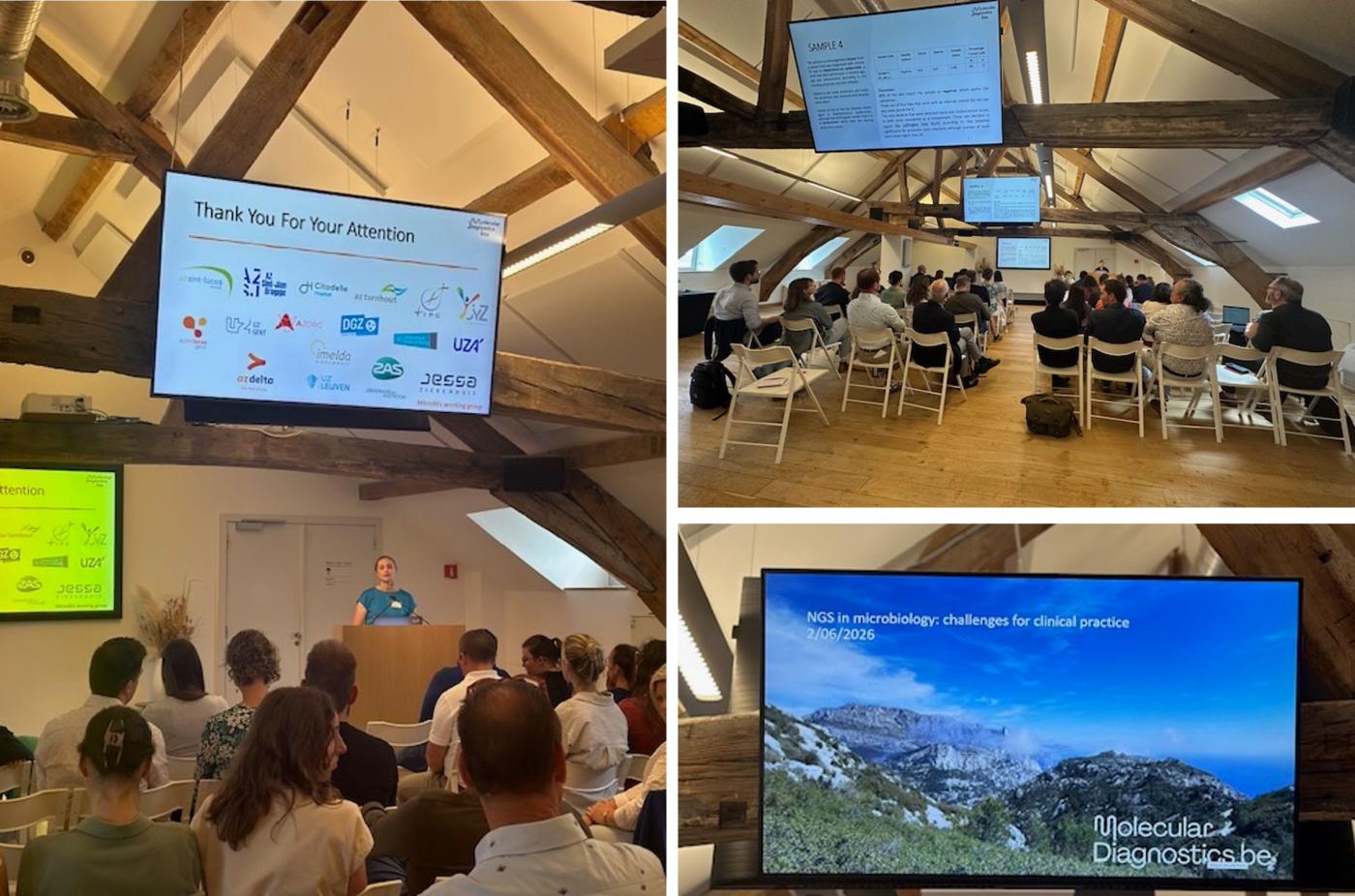
On 2 June, the Scientific Spring Meeting of the NGS in microbiology working group took place at the BIP Meeting Center in Brussels. Under the theme “NGS in microbiology: challenges for clinical practice”, experts from the field gathered to discuss the current state of next-generation sequencing (NGS) in microbiological diagnostics and its path towards routine implementation.
The meeting was opened with a warm welcome by the presidents of the NGS in microbiology working group, dr. Anne Vankeerberghen and dr. Elke Vanlaere, who set the stage for a day filled with scientific exchange, practical insights and lively discussions.
The scientific programme kicked off with dr. Jozef Dingemans, who provided an overview of the different options currently available for DNA extraction, library preparation and data analysis in 16S rRNA sequencing. He also shared the experience of Jessa Hospital with implementing 16S rRNA sequencing of clinical samples as a routine molecular diagnostic assay, highlighting both the opportunities and challenges of integrating this technology into daily practice.
Next, dr. Fien De Winter and dr. Florence Crombé presented the 16S ring trial results from the NGS in microbiology working group, which led to an interactive discussion with the audience followed by brainstorming how a follow-up ring trial could be organized, followed by a comparison of Sanger versus Nanopore 16S sequencing presented by dr. Fien Ghysens and dr. Laurenz De Kock.
There was also room for the clinical practice of 16S sequencing as several (assistant) clinical biologists (dr. Otto Van de Gaer, dr. Marthe Vanrenterghem, and dr. Robin Vanstokstraeten) presented interesting case studies in which the 16S method showed added value but also revealed some pitfalls that can come with its implementation in a routine diagnostics laboratory.
After a well-deserved lunch break, dr. Koen Swaerts highlighted the importance of using curated databases and presented his automated cloud-based bacterial identification pipeline using long-read ONT 16S and 16S-23S rDNA sequencing data before switching to the CLARIFY study that was presented by Prof. dr. Geert Martens in which full length 16S Nanopore sequencing was evaluated for gut microbiome profiling as a tool to diagnose Inflammatory Bowel Disease.
Just before the coffee break, dr. Merijn Van Hee guided the audience through the challenges of fungal diagnostics, exploring the complexities of panfungal Nanopore sequencing in what he described as a “fungal jungle”.
After the coffee break we switched from human to animal health as dr. Sara Malfait from DGZ Vlaanderen compared PCR to Nanopore sequencing for Porcine Circovirus 2 subtyping and finally the scientific programme was closed by a duo presentation from dr. Hannelore Hamerlinckx and dr. Klaartje De Rauw who presented about a Nanopore-only whole-genome sequencing workflow for genomic surveillance of multidrug-resistant Klebsiella pneumoniae.
The meeting provided an excellent platform for knowledge exchange between microbiologists, clinical biologists and researchers, underlining both the potential and the remaining challenges of bringing NGS technologies into routine microbiological practice.